Create Pre-Order Account   |   View My Account / Log In   |   Contact Us


    In Stock Games      Final Development Games      Customer Pre-Order Games

Adobe Walls

Corregidor

Fire on the Mountain

Hell Over Korea 

Redvers Reverse

Russo-Japanese War

Slouch Hats
& Eggshells

Soissons 1918

Tatchanka!

Tonkin


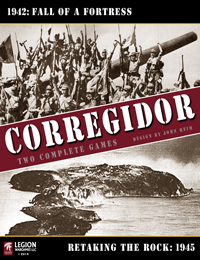
Corregidor:
Fall of a Fortress -1942/1945
by John Heim

Corregidor is a simulation of the two battles fought for Corregidor and the fortified islands at the entrance to Manila Bay during World War II.  The first battles began with the bombing of the island in early 1942 and ended in May of that year with it's surrender.

After General Douglas MacArthur's return to the Philippines, Corregidor once again became a target of invasion, both to avenge the loss three years before and to clear the mouth of Manila Bay to Allied shipping.

Corregidor: Fall of a Fortress 1942/1945, includes two games. The first game recreates the Japanese bombardment and invasion in 1942 and the second simulates the American airborne invasion and re-conquest in 1945.


EXTENDED GAME DESCRIPTION:

CORREGIDOR is played in successive game turns composed of alternate player turns during which the phasing player maneuvers his units and resolves combat in sequence. Turns consist of the Administrative Phases (reinforcement arrival, disruption removal, Fired marker removal), the Air Attack Phase (which includes airborne assault), first Player Turn (AA fire, bombardment, invasion, ground movement, and combat), and then the second Player Turn.

Some detail features of the game are tracking Japanese landing craft losses, American communications disruption, U.S. air and naval support points, unit disruption levels, and which artillery units have fired.

The six hexes adjacent to an undisrupted land unit constitute that units Zone of Control. Disrupted land units DO NOT have ZOCs, and therefore judicious use of support to disrupt enemy units allows the attacker to infiltrate through weak positions and to launch flanking attacks against defending units. This is critical because defending units are doubled and sometimes tripled by the rugged terrain and the unique features on the maps, such as rough terrain, cliffs, elevation changes, tunnels, towns, and coast defense artillery emplacements.

In the 1942 scenarios, there is a cat-and-mouse game which develops between the Japanese artillery and air units versus the American artillery and anti-aircraft defenses. Aircraft need to designate the altitude at which they conduct bombing  the lower the attack level the more accurate the bombing, but also the more accurate the AA fire. Similarly, artillery which fires is more vulnerable to counter-battery fire and so making a bombardment attack must be weighed against the possibility of return fire.

In 1945, in addition to banzai options, the Japanese have the option to make suicide demolitions, which destroy the attacking unit but also damage adjacent units. There is a mechanism to occasionally compel such attacks, which not only forces some historicity but it also models the uncoordinated local Japanese command structure in 1945.

Some optional rules included:

Spike Rule - U.S. Batteries must be spiked when Japanese units come within two hexes to prevent them from being captured in usable condition. They may not be voluntarily destroyed until after a Japanese unit has landed on their island. Flip the battery over after the following U.S. Bombardment Phase. The unit may then move and fight normally.

Restored Batteries - Roll one die on the turn of the American invasion in 1945 for the surviving former U.S. batteries:
 1 - Battery may fire normally.
 2 - Battery sabotaged by POWs, gun crew fights as infantry.
3-6 - Battery was never manned; remove from map.

Additional U.S. Batteries - Three 240mm howitzer batteries which were to be installed in 1922 actually arrive. One battery is deployed anywhere on Fort Frank, one on Fort Hughes, and one on Fort Mills (Corregidor).

Philippine Division Transferred - The 31st, 45th, and 57th Regiments are transferred to Corregidor prior to the fall of Bataan. Add them to the available U.S. forces in Scenario 11.1. Due to the effects of fighting on Bataan, plus short rations and disease, these units are deployed at reduced strength. As an additional option, they may be deployed at full strength to simulate these units being in better condition historically.

Itagaki Rule - Japanese defense commander Capt. Itagaki did not believe an airborne assault could be made on Corregidor. He was killed on Topside during the initial paradrop, while waiting to observe the amphibious assault for which he had prepared. Additionally, his central communications station was overrun very quickly by the paratroops. In this rule, he is killed and no Japanese unit may move until the first night turn.

U.S. Roving Batteries - During the campaign for Bataan and Corregidor, the U.S. created a number of "roving batteries" of 155mm guns by removing them from their emplacements and mounting them such that they could be moved about Corregidor.

U.S. Searchlights - The U.S. had several searchlight batteries on the Fortified Islands. This option forces the Japanese to actually expend the effort to destroy them and if they are not, they provide some advantage to the U.S. Player.

If a Japanese invasion or evacuation is occurring in a night turn and there is an active U.S. searchlight unit on the map, the U.S. Player receives a +2 die modifier (cumulative with any other DRMs) when firing on Japanese units in water hexes.

If a Japanese air bombardment is conducted at night, U.S. Anti-aircraft fire receives an additional +1 modifier to any other DRMs which apply; Japanese Bombardment rolls receive an additional -1 modifier to any other DRMs which apply.

Battery Way - Battery Way did not have a crew and was not operational until April 28. The U.S. might have activated this battery sooner. Roll at the beginning of the 0300 daily turn. The battery is active at full strength on a roll of 2 or 12. The battery becomes active automatically on Turn 65 if not activated sooner.


Playtest Counter Samples
(click to enlarge)


Playtest Map  (click to enlarge)


ConsimWorld Discussion Folder
Here is a link to the CSW discussion folder where you can ask the designer questions, see what others are saying, and get progress updates on the release of the game. 


Playtest Rules

Books to Read  


Designer Notes


Discussion Folder


Examples of Play 

February 16th, 1945
Turn 1:  0800 hours


CPO Game of the Month

In July 2009 we featured this game and the battle behind it,  with additional graphics, designer notes, examples of play, a game discussion folder, historical articles, website links, book reviews and more.

Corregidor: Fall of a Fortress
1942/1945
game design by John Heim 


Battle for Corregidor Stories


Websites Covering the Battle

Game scale:

Units: Infantry platoons and artillery batteries
Map: Each hex equals 250 yards
Turn: Each game turn represents 2-3 hours  

Corregidor
$58(estimated retail price)
Pledge Price $46 + Shipping 

Game Components:

Map: one 22" x 34" map
Counters: 540 - 5/8" die-cut counters
Rules: 24 page rule book 
Charts: 4 game play charts
Box: boxed with a slip-cover

BACK TO TOP OF PAGE                                L  E  G  I  O  N     W  A  R  G  A  M  E  S                                BACK TO TOP OF PAGE