
|
CPO Games Scheduled for Production in 2012 | ||||||
|
The Invasion of German East Africa
Designer: Dennis L. Bishop
Often referred to as 'The Battle of the Bees', the Battle of Tanga, an amphibious attack launched by British and Indian forces, established the burgeoning reputation of Colonel (later General) Paul von Lettow-Vorbeck by the manner in which he successfully beat off the British-led attempt to capture German East Africa. A costly defeat, the attack at Tanga had cost the British 847 casualties (including 360 fatalities). In turn the Germans had suffered 67 deaths (from a total of 148 casualties), but Lettow-Vorbeck gained much booty from the supplies left behind by the British in their hasty retreat, including machine guns, rifles and 600,000 rounds of ammunition.
| ||||||
|
| ||||||
|
Indian Wars of the American West- Volume III
The Battle of Adobe Walls
November 26th, 1864
Designer: Michael Taylor
Also known as the First Battle of Adobe Walls, it was one of the largest battles between U.S. and Great Plains Indians. Kit Carson was given command of the US forces, and his mission was to find the Comanche and Kiowa winter camps and eliminate this threat to the settlers that were moving into the Texas panhandle. Adobe Walls shares many similarities with Little Bighorn. The battle features a famous US leader in Kit Carson, attacking a large Indian camp along a river with a much smaller US force. He is also temporarily separated from the pack train, and the size of the Indian force was greatly underestimated. Adobe Walls adds a new weapon to the series, the Mountain Howitzer.
| ||||||
|
| ||||||
|
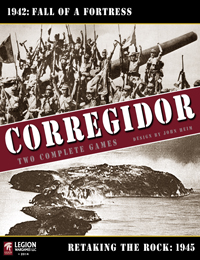
Fall of a Fortress - 1942/1945
Designer: John Heim
Corregidor: Fall of a Fortress 1942/1945, includes two games, the Japanese bombardment and invasion in 1942 and the American re-conquest in 1945. The first battle covers the Japanese bombing of the island in early 1942 that ended in May of that year with the surrender of US forces to the Japanese. The second simulates the American airborne invasion after General Douglas MacArthur's return to the Philippines , Corregidor once again became a target of invasion, both to avenge the loss three years before and to clear the mouth ofManila Bay to Allied shipping.
| ||||||
|
| ||||||
|
The Battle of Colenso, 1899
Designer: Geoff Noble
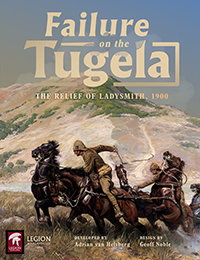
On the 15th December 1899 General Sir Redvers Buller tried to cross the Thukela River in order to relieve the Siege of Ladysmith. He was faced by well entrenched Boer commandoes who inflicted a reverse upon the British that ultimately led to Buller being relieved of command. Redvers Reverse is a solitaire area movement game that recreated the difficulties for the British in trying to affect a successful crossing of the Thukela against the Boer commandoes (who are played by the game system). The key feature of the game is to present the player with the problems and difficulties that Buller himself faced. The player is provided with the same level of information and ability to influence events.
| ||||||
|
| ||||||
|
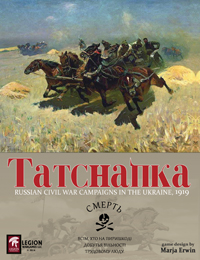
Russian Civil War Campaigns in the Ukraine, 1919
Designer: Marja Erwin
The October Revolution brought civil war in the Cossack lands; the German invasion brought guerilla war in the Ukraine. The German collapse only spread the war. All sides expected this war to decide the future of Ukraine and Russia and all were determined to win at any cost. The decisive battles came in the fall of 1919. The Volunteer Army took Voronezh and Orel before mounting losses and Red Army counterattacks forced their retreat. Meanwhile, the Revolutionary Insurrectionary Army of Ukraine broke through the White lines, taking Taganrog and Yekaterinoslav. By the end of 1919, the Bolsheviks and the Red Army had won. The Armed Forces of South Russia were retreating into the Crimea and Caucasus, while the Army of the Ukrainian National Republic was dispersing into partisan bands.
| ||||||
|
| ||||||
|
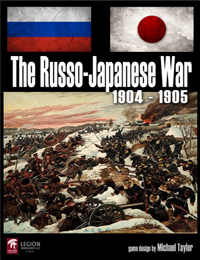
Russo-Japanese War, 1904 - 1905
Designer: Michael Taylor
Russo-Japanese War is a detailed, operational-level game that models the historical 1904-05 campaign in Manchuria. The game is designed for two players, but can easily accommodate additional players. For example, each side might have separate naval and ground commanders and/or multiple ground commanders. The Russian player controls the Russian ground and naval forces. The Japanese player controls the Japanese ground and naval forces. The Russian player must defend Russian possessions in Manchuria while building up his armies by reinforcement from Siberia and European Russia, and then inflict unacceptable losses on his opponent and force him to sue for peace. The Japanese player must quickly defeat the Russian army before it can reinforce itself. Both sides must avoid heavy losses and a protracted war. Russian National Will and social unrest may bring on the downfall of the monarchy, while Japan has very limited resources (human, military and financial).
| ||||||
|
CPO Series Games in Pre-Order Status | ||||||
|
Designer: Michael Taylor
Reprint of the CSR Award Winner: Best Desktop Published Wargame, 2006. Battle of the Little Bighorn is a tactical level, two player game, with each player commanding either the US Cavalry or the combined tribes of the Plains Indians. The game includes Leaders, Mounted/Dismounted troops, Melee & Fire Combat, Ranged Fire, Morale, Villagers, Pony Herds, Horse Holders and Ammunition Supply.
| ||||||
|
| ||||||
|
Designer: Michael Taylor
Reprint of the CSR Award Winner: Best Desktop Published Wargame, 2007. Battle of the Rosebud preceded the battle of the Little Bighorn by a week, the outcome of this battle directly influenced what happened to Custer and the 7th US Cavalry.
| ||||||
|
| ||||||
|
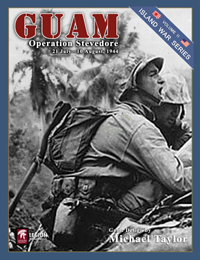
Island War Series- Volume II
Guam
Operation Stevedore, 1944
Designer: Michael Taylor
The Island War Series game system is a simulation of ground combat in the Pacific during World War II. Each game in the system represents a battle between Allied and Imperial Japanese forces on one of the many Pacific Islands. Two sets of rules are provided with each game. The first contains the Standard Rules that are common to all the games in the Island War Series. The second set contains the Exclusive Rules for each game in the system, which includes Special rules, the Initial Deployment and the Reinforcement Schedule. Generally the unit scale is battalion, but there are company and platoon formations represented. The time scale is 1/2 day per turn.
| ||||||
|
| ||||||
|
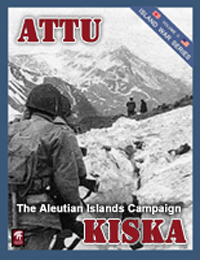
Island War Series- Volume III
Attu & Kiska
Aleutian Islands Campaign, 1943
Designer: Michael Taylor
The Island War Series game system is a simulation of ground combat in the Pacific during World War II. Each game in the system represents a battle between Allied and Imperial Japanese forces on one of the many Pacific Islands. Two sets of rules are provided with each game. The first contains the Standard Rules that are common to all the games in the Island War Series. The second set contains the Exclusive Rules for each game in the system, which includes Special rules, the Initial Deployment and the Reinforcement Schedule. Generally the unit scale is battalion, but there are company and platoon formations represented. The time scale is 1/2 day per turn.
| ||||||
|
| ||||||
|
SHS Series- Volume I
The Battle of Blenheim
August 13th, 1704
Designer: Steven Pole
The Battle of Blenheim is a tactical level two player game covering one of the pivotal battles during the War of Spanish Succession. One player takes the role of Marlborough, commanding the British and Allied forces, and the other of Tallard, leading the Franco-Bavarians. At Blenheim Marlborough found himself confronting a superior Franco-Bavarian force in a strong defensive position. Like Hannibal's great victory at Cannae, Blenheim was won by the successful implementation of a bold and imaginative plan. The flanks of the Franco-Bavarian forces were pinned by furious attacks at unfavourable odds which denuded their centre of troops re-deployed to buttress the hard-pressed wings. Then Marlborough released his cavalry to smash what was left of Franco-Bavarian centre and cleave Tallard's army into two. The threat that Louis VIV's France would come to dominate Europe was over.
| ||||||
|
CPO Non Series Games in Pre-Order Status | ||||||
|
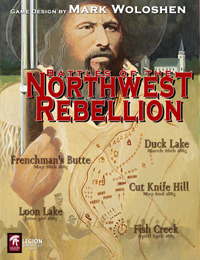
Saskatchewan, Canada, March - May, 1885
Designer: Mark Woloshen
Five Battles of the Northwest Rebellion
| ||||||
|
| ||||||
|
March 13 - May 7, 1954
Designer: Kim Kanger
"Dien Bien Phu" depicts the decisive battle which took place in a distant jungle valley in northern Vietnam. It was a battle where both sides knew from start would be a final showdown. The French were desperately seeking for an opportunity to bring the Viet Minh main battle force into battle on French terms. Dien Bien Phu was a trap where superior units and weapons would crush the Viet Minh onslaught. The Viet Minh felt they could not win the war unless they managed to upgrade their mode of fighting into a full scale war. The French were too strong in the delta but in a distant valley they had gathered almost all their best units without whom France would lose their will to continue. Dien Bien Phu was the place where France would be dealt a crushing defeat.
| ||||||
|
| ||||||
|
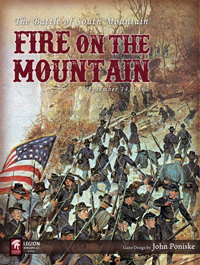
The Battle of South Mountian - September 14, 1862
Designer: John Poniske
Fire on the Mountain is a simulation of the Battle of South Mountain and concentrates on the action around Turner's Gap and Fox's Gap. It will emphasize the difficulty of mountainous terrain and the seesaw nature of a battle into which reinforcements continue to trickle and officer casualties effect combat operations. The game uses simple mechanics to simulate movement, artillery, cavalry, leaders, and difficult terrain, with a unique combat system that allows the game to move quickly while still simulating the tense nature of the battle. The game will be produced with double-wide counters (1 1/4" x 5/8") and oversized hexes to accomodate them.
| ||||||
|
| ||||||
|
Rival Empires in Central Asia 1837-1886
Designer: John Gorkowski
The Great Game recreates the 19th Century Anglo-Russian struggle for supremacy in Central Asia. In the actual contest, Tsarist Russia resented British expeditions into the Steppe Khanates while Victorian Britain feared that Russian entreaties to Persia and Afghanistan would jeopardize India’s security. So the two imperial powers wove a complex tale of diplomatic intrigue, colonial conquest and proxy wars that spanned 50 years. In the game, players alternate moving officers (historical personalities) and troops across a point-to-point map of Central Asia in yearly turns. Imperial powers strive to enlist vassal states such as Afghanistan and Bokhara into their camp through diplomacy or combat. Random events such as the Crimean War, Sepoy Mutiny and American Civil War intrude to make each game different.
| ||||||
|
| ||||||
|
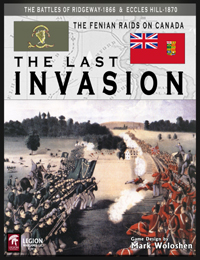
The Fenian Raids on Canada - 1866 & 1870
Designer: Mark Woloshen
This is a pair of games, covering the battles of Ridgeway (1866) and Eccles Hill (1870), when large numbers of well armed and trained Fenians crossed the U.S. - Canada border. There goal was to take territory in an effort to put pressure on the British government.
| ||||||
|
| ||||||
|
New Zealand, 1845 - 1872
Designer: John Poniske
Maori Wars is a simulation of the principal uprisings that took place Between 1845 and 1872 due to British colonial incursions into native Maori lands on the North Island of New Zealand. Conflict involved the destruction of numerous villages, pas (strongly fortified villages that featured intricate trenchworks) and colonial settlements. The war introduced the British to a wily well-armed enemy whose defense works and strategy of ambush surprised and stymied them. As scenarios progress so does the extent of the conflict. More British regulars, native born Australian troops and New Zealand militia enter and are allied with increasingly more tribes who tend to change sides at the most inopportune times (those supporting the British came to be known as Queenites).
| ||||||
|
| ||||||
|
U.S. Destroyers off the Coast of Okinawa, 1945
Designer: Steve Dixon
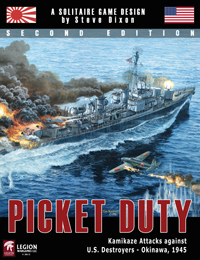
By the time of the invasion of Okinawa in April 1945, the US Navy devised a plan to help ward off the expected kamikaze attacks during the battle for the island. In order to provide an early warning system for impending kamikaze attacks, the US Navy established 16 radar picket stations around the island. Picket Duty is a solitaire game where you -- as the captain of a Fletcher Class destroyer – fend off kamikaze attacks while performing picket duty off Okinawa. The game covers the time period from late March 1945 to late June 1945. Your goal is simple – survive. The game comes with a basic game, advanced game, six historical scenarios, two hypothetical scenarios, a mini-campaign and a full campaign. Optional rules are also included. Each game turn is divided into three phases, each depicting an eight hour period. Key crew members are depicted with certain functions, as well damage control teams. 27 types of Japanese planes are represented. Some planes have special attack capabilities.
| ||||||
|
| ||||||
|
18 July to 28 July, 1918
Designer: Tim Gale
The Battle of Soissons, 18 July to 28 July, 1918, is little known today, particularly in the English-speaking world. It is significant for a number of reasons; it was the first time that the French army used a large-scale attack with tanks supported by a surprise (i.e. not pre-registered) artillery bombardment, similar to the British attack the previous year at Cambrai, and it was the first time that full-size US divisions went on the offensive incorporated in the French army. But most importantly, it was the opening of the Second Battle of the Marne. It not known at the time, although suspected by many, that this battle was the death-knell of the German army.
| ||||||
|
| ||||||
|
The British Invasions of Argentina 1806-1807
Designer: Joseph Miranda & Javier Romero
The Waters of Oblivion is an operational level wargame of the British attempt to conquer the River Plate area. The British invasions of the Rio de la Plata were a series of unsuccessful British attempts to seize control of the Spanish colonies located around the La Plata Basin in South America (today part of Argentina and Uruguay). The invasions took place between 1806 and 1807, as part of the Napoleonic Wars, when Spain was an ally of France. The invasions occurred in two phases. A detachment from the British Army occupied Buenos Aires for 46 days in 1806 before being expelled. In 1807, a second force occupied Montevideo, remaining for several months, and a third force made a second attempt to take Buenos Aires. After several days of street-fighting against the local militia and Spanish colonial army, in which half of the British forces were killed or wounded, the British were forced to withdraw.
| ||||||
|
How the Customer Pre-Order (CPO) Program Works | ||||||
|